

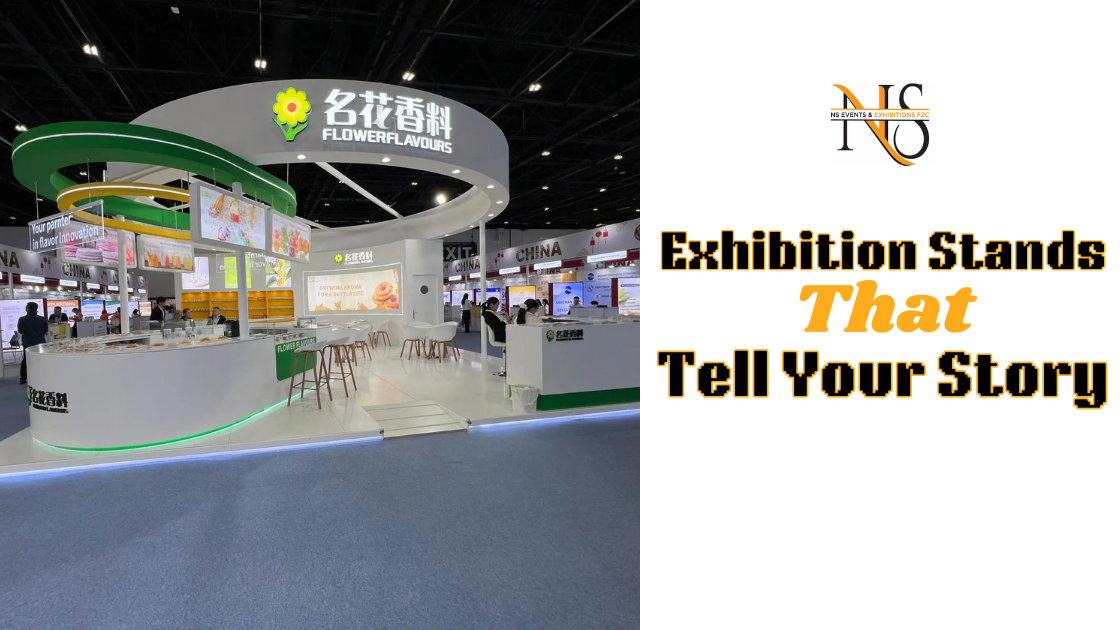
Brand storytelling in an exhibition stand means designing every physical and sensory element, layout, graphics, materials, lighting, and staff interaction, to communicate a coherent narrative about who you are, what you stand for, and why this visitor should care. Stands that tell a clear, purposeful story retain visitors 40–60% longer than informational displays that simply list products and services.
In Dubai’s competitive exhibition environment, the majority of stands communicate through product lists, feature bullet points, and brand logos. This is not storytelling, it is cataloguing. And cataloguing is exactly what your competitors are already doing.
The brands that stand out and generate the most productive exhibition conversations are those that have a clear answer to one question: ‘What story does someone experience when they walk through our stand?’ This guide gives you the framework to build that story intentionally.
Why Brand Storytelling Works in Exhibition Environments
Human brains are wired for narrative, not data. When visitors encounter a stand that tells a coherent story, they engage, retain information, and form emotional connections that translate to business conversations. When they encounter a stand that lists features, they read the key points, take a brochure if one catches their eye, and move on.
Stand Type | Average Dwell Time | Information Retained |
| Meeting Conversion |
Product catalogue / feature list display | 45–90 seconds | Product name, 1–2 features |
| Low — visitor felt no connection |
Problem-solution narrative stand | 3–8 minutes | Core problem addressed, brand approach, 1 specific example |
| Medium — rational engagement |
Full story experience (visual + physical + human) | 8–20 minutes | Brand identity, specific value, personal connection to team member |
| High — emotional + rational engagement |
These are not theoretical differences. They are consistent findings across multiple Dubai exhibition post-event surveys. The stands that tell compelling stories consistently report higher lead quality, higher dwell time, and higher post-event conversion rates than those that display product catalogues.
The Four-Stage Exhibition Story Framework
Every visitor who approaches and enters your stand goes through four distinct experience stages: the approach (what do they see from a distance?), the entry (is this relevant to me and safe to enter?), the engagement (does this solve my problem?), and the commitment (what do I do next?). Each stage requires different design and communication decisions.
Stage 1: The Approach (0–3 seconds, 5–20 metres away)
At this stage, visitors make a subconscious binary decision: is this relevant to me or not? They cannot read detailed copy. They process: colour, scale, one dominant image or message, and emotional tone. Your design must answer the question ‘What is this?’ within a single glance.
- Design requirement: One dominant visual element, structural, graphic, or lighting, that communicates brand identity instantly
- Copy requirement: 3–5 word statement visible from 10–15 metres that communicates the core brand promise
- Emotional signal: The stand’s visual tone should signal whether this is a premium brand, an approachable one, a technical authority, or an innovative challenger
Common mistake at this stage: Too much visual information at approach level. Visitors presented with 6 product images, a company logo, a tagline, and three graphics panels simultaneously process none of them. Reduce until one message dominates.
Stage 2: The Entry (3–15 seconds, 2–5 metres away)
The visitor is now close enough to read. They are making a second decision: ‘Is this relevant enough to stop, and is entering this space comfortable?’ Physical barriers at the stand entry, counters that act as walls, standing display units blocking the path, closed or semi-enclosed configurations, create friction that dramatically reduces entry rates.
- Design requirement: Open entry points with no threshold barriers; at least one clear walking path into the stand
- Copy requirement: One specific, resonant claim that speaks to a real problem your audience faces, not a generic value statement
- Human requirement: A team member makes eye contact and acknowledges the visitor within 3 seconds of them entering the 3-metre perimeter
Dubai-specific note: UAE business culture responds strongly to hospitable, welcoming body language. A warm, professional greeting, not a sales pitch, is the culturally correct entry experience. Staff who stand with crossed arms or focused on their phones create the wrong first impression regardless of stand design quality.
Stage 3: The Engagement (15 seconds–10 minutes)
The visitor has entered the stand and is engaging. This is where the story gets told in depth. The physical environment, the conversation with your team, and the interactive elements should all be working together to answer the visitor’s core question: ‘Does this organisation solve a problem I have?’
- Story structure for this phase: Problem → Your approach → Specific example → Evidence → Next step
- Graphic content should use problem-solution framing, not product feature lists
- Case study displays should show recognisable client names where possible, regional brand recognition carries significant credibility in Dubai
- Data points should be specific and credible: ‘43% cost reduction for a leading UAE telecom client’ outperforms ‘40% cost savings for enterprise clients’
The conversation arc for your team at this stage should follow: open question about the visitor’s context → active listening → connecting their situation to your specific capability → illustrating with a concrete example → proposing a next step.
Stage 4: The Commitment (Post-engagement)
The visitor is now ready to take a next step. The design and process at this stage determines whether your team converts a good conversation into a qualified opportunity or loses the thread.
- Clear CTA: Every visitor who has a substantive conversation should have a clear, frictionless next step offered, meeting booking, demo registration, digital brochure sent directly to their email
- Memorable leave-behind: Something with genuine utility rather than a generic giveaway, a specific insight report, a calculation tool, a relevant checklist
- Lead capture that doesn’t feel transactional: Badge scan with a personal note, not just a scan number in a database
Cultural Storytelling Calibrations for the UAE Market
Storytelling that works in European or North American exhibitions requires calibration for the UAE audience. These are the specific cultural factors that determine whether your story resonates in Dubai:
Cultural Factor | What It Means for Your Story | Practical Application |
Relationship primacy | The relationship comes before the transaction | Lead with partnership narrative, not product features |
Respect for heritage and longevity | How long you’ve been doing this matters | Communicate experience, longevity, and track record prominently |
Visual proof | Claimed results are less credible than demonstrated results | Case studies, client logos, and measurable outcomes are essential |
Hospitality as respect | Offering refreshment signals serious relationship intent | Hospitality zone with premium refreshments is not optional in B2B |
Senior engagement expectation | Senior visitors expect senior-level interaction | Always have a senior representative at the stand |
Innovation aspiration | Dubai’s identity as a forward-looking city | Innovation and future-facing narratives resonate strongly |
Regional relevance | Middle East examples outperform global examples | Always lead with UAE/GCC case studies and regional context |
Story Architecture: How to Build Your Exhibition Narrative
Before any design brief goes to your contractor, these story architecture decisions should be made:
1. Define the One Thing
What single idea do you want every visitor to carry away from your stand? Not three things, one. This becomes your design anchor. Everything else should support this central message.
2. Identify the Enemy
The most powerful brand stories are built around a problem, challenge, or undesirable status quo that your brand resolves. What is the ‘enemy’ your brand fights? Inefficiency? Complexity? Risk? Cost? Making the enemy visible makes your solution feel relevant and timely.
3. Demonstrate Don't Describe
In the exhibition environment, showing is exponentially more powerful than telling. If you can demonstrate your product or service, design the demonstration into the stand rather than describing it in a brochure. Live demonstrations are the highest-conversion exhibition tactic available.
4. Evidence at Every Stage
Every claim your story makes should have a form of evidence visible in the stand environment: case study panels, client logo walls, data visualisations, real product examples, live demonstrations. In Dubai’s business culture, social proof from recognisable regional brands is particularly powerful.
Frequently Asked Questions
How do I translate our brand story into physical exhibition design elements?
Start with the story architecture (the one message, the problem, the evidence), then brief your designer on how to express each story element physically. The problem can be expressed as a graphic journey. The solution can be expressed as a demonstration zone. The evidence can be expressed as a case study wall. A good exhibition designer translates narrative into spatial experience, but they need a clear narrative to start from.
How long should our team's standard conversation be at a Dubai exhibition?
Initial qualification conversations should be 3–5 minutes, enough to establish relevance and context. If a visitor shows genuine interest, move to a seated meeting environment (even briefly) for a more substantive 15–30 minute conversation. The transition from standing hallway conversation to seated meeting is a critical conversion moment, train your team to make this invitation naturally
How do we tell a consistent story across multiple exhibitions?
Develop a brand exhibition playbook that covers: the core story architecture, approved graphic assets, the standard conversation arc for each visitor type, the lead capture protocol, and the follow-up process. With this playbook, different team members at different events can tell consistent stories with personal variation, the structure is consistent, the delivery is human.