

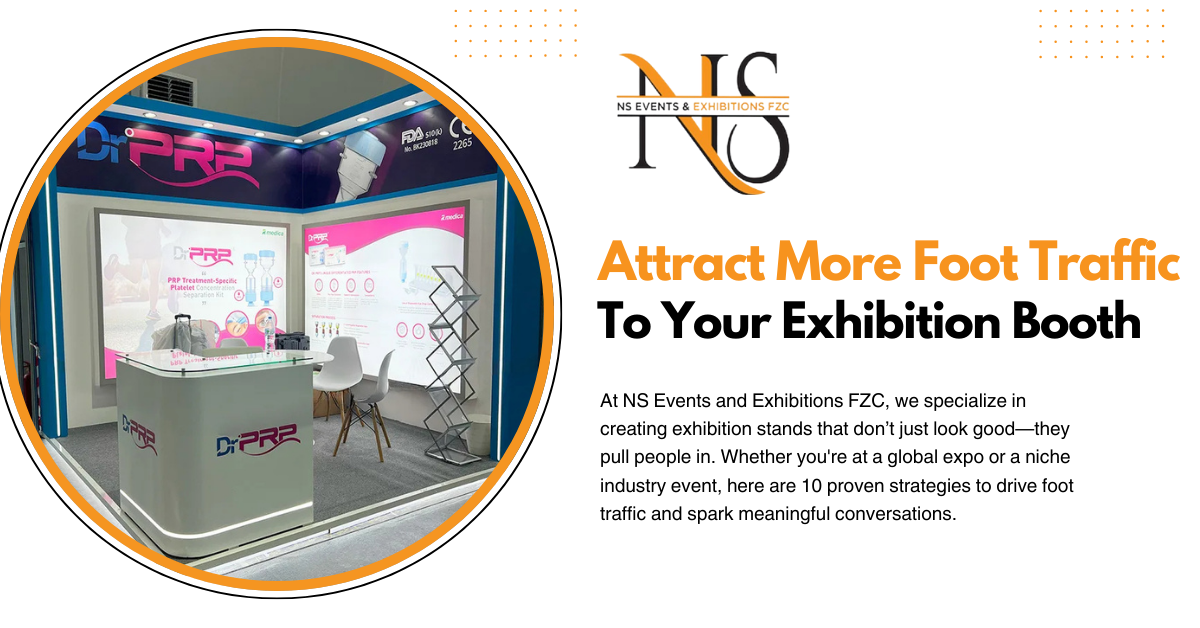
Attracting foot traffic to your Dubai exhibition booth requires three parallel strategies: pre-show digital promotion that gets your brand on visitors’ must-see lists before they arrive, on-floor visual and spatial design that draws walk-by visitors at 20-metre distance, and proactive staff behaviour that converts passing attention into meaningful conversations. Research shows 70–80% of exhibition traffic is predetermined, getting onto visitors’ plans before show day is your most important action.
Most exhibition footfall strategies focus on the wrong stage. They invest in the stand design and on-site tactics while neglecting pre-show marketing, which is where the majority of visitor decisions are actually made. This guide covers all three stages with specific, actionable tactics for Dubai’s exhibition environment.
Understanding Dubai Exhibition Visitor Behaviour
Before implementing footfall tactics, understanding how Dubai exhibition visitors actually plan their show visits changes your strategic prioritisation significantly:
Visitor Behaviour | Percentage | Implication |
Plan their show route in advance using the show app or floor map | 70–80% | Pre-show marketing is your primary traffic generation lever |
Visit stands they knew before the show | 55–65% | Brand awareness before the show is essential |
Visit a stand based on on-floor visual attraction | 35–45% | Stand design and approach visibility matters significantly |
Visit based on recommendation from another attendee | 25–35% | Your pre-show engagement network creates referral traffic |
Visit based on scheduled meeting | 20–30% | Pre-scheduled meetings are the highest-quality traffic source |
Stage 1: Pre-Show Traffic Generation
Pre-show marketing is the highest-return investment in exhibition traffic generation. Every visitor who comes to your stand because of pre-show activity was already qualified before they arrived, they sought you out specifically. This is categorically more valuable than walk-by traffic from visitors whose interest you have not previously established.
Digital Pre-Show Checklist (Begin 4 Weeks Before Show Day)
- LinkedIn company page announcement with stand number, hall, and a specific reason to visit (product launch, demo, giveaway, scheduled session)
- Personal LinkedIn posts from all senior attending staff, personal posts outperform company page posts by 3–10x in organic reach
- Email invitation to existing clients, warm prospects, and relevant contacts with personalised message referencing their specific situation
- WhatsApp broadcast to UAE-based contacts, this channel achieves highest open rates for business communication in the GCC
- Registration and activation on the show’s official matchmaking platform (GITEX, Gulfood, Arab Health all have these, use them)
- Request to be featured in the organiser’s pre-show exhibitor spotlights and email newsletters
- Second LinkedIn reminder 2 days before show opens, algorithm timing means the first announcement is missed by a significant portion of your network
- Schedule a minimum of 8–12 confirmed meetings before the show opens
- Create a landing page or calendly link for meeting bookings at your stand, reduce friction for scheduling
- Brief your full team on pre-scheduled meetings with attendee profiles, company context, and conversation priorities
Stage 2: On-Floor Visual Traffic Generation
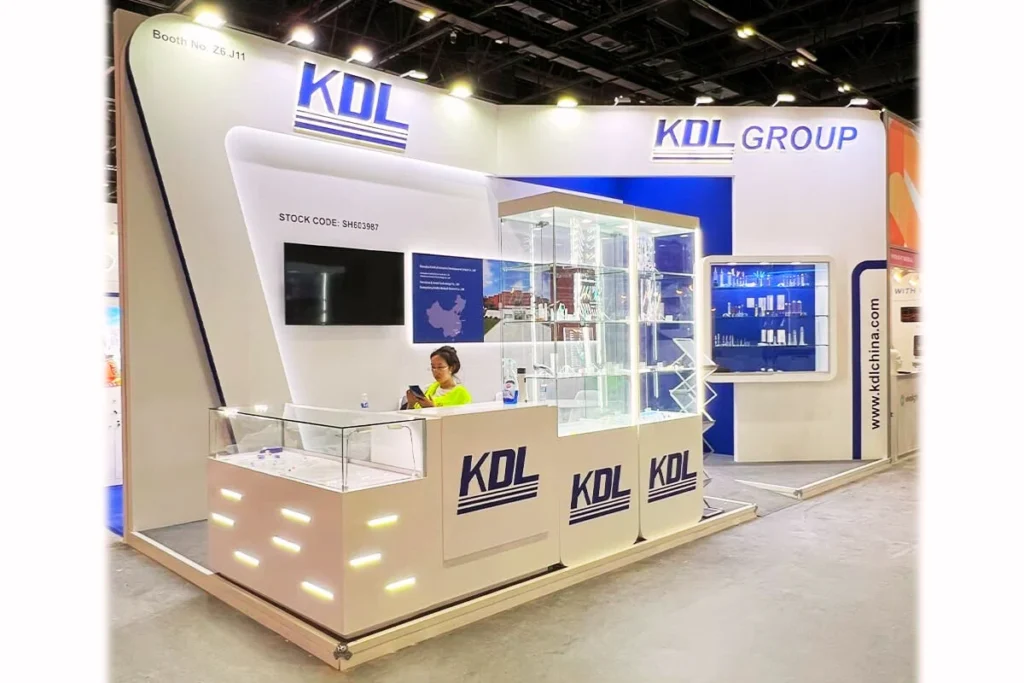
On-floor visual tactics are the second driver of exhibition traffic. Your stand needs to be visible and legible from three distances, far field (20m+), mid field (5–20m), and near field (under 5m), with each zone communicating different information to convert distant interest into stand entry.
The Three Visibility Zones Framework
Zone | Distance | Primary Goal | Design Focus | Copy Focus |
Far Field | 20m+ | Brand awareness — ‘That stand exists’ | High-contrast brand colour, suspended signage, motion LED, height | Brand identity only — logo or one iconic visual |
Mid Field | 5–20m | Relevance — ‘That stand might be for me’ | Clear stand name, structural distinctiveness, staff visibility | 3–5 word value statement in large, legible type |
Near Field | Under 5m | Entry — ‘I’ll walk in’ | Open entry points, welcoming human presence, one specific content element | Specific problem statement or clear CTA |
Height and Vertical Visibility
Vertical elements are disproportionately valuable in crowded exhibition halls. A 3-metre branded column is visible from 25+ metres when competitor stands are at 2.5m. Suspended overhead signage extends brand visibility to the entrance of the hall. DWTC has specific restrictions on suspended element height and rigging requirements, confirm these with your contractor and the show organiser before designing.
Motion Attracts Attention
Motion, whether physical (rotating displays, moving elements) or digital (LED motion content), consistently attracts more attention than static displays in a visual-overload environment. The human eye is neurologically primed to detect movement. A static branded panel and a moving LED panel at the same size will not attract equivalent attention.
Crowd-Drawing Physical Elements
- Live demonstrations with scheduled session times: Scheduled sessions create an audience that draws additional audience
- Visible activity: Stands where something is visibly happening (demonstration, conversation, technology interaction) draw more visitors than stands where nothing appears to be happening
- Interactive technology: Touchscreens and AR experiences create visible queue activity that signals ‘this is worth stopping for’
- Premium refreshments: A visible barista station or branded refreshment display draws visitors who then receive your engagement, one of the most consistent footfall drivers in Dubai’s B2B exhibition culture
Stage 3: Staff Behaviour, The Highest-ROI Traffic Tactic
Your team’s behaviour is the single highest-leverage variable in stand traffic conversion. A compelling stand with passive staff converts significantly less traffic than a mid-range stand with proactive, well-trained team members. The specific behaviours that matter most are defined below.
The Three-Second Rule
Every staff member should make eye contact and provide a warm acknowledgement to anyone who enters a 3-metre radius of the stand within 3 seconds of them doing so. This one behaviour change, consistently implemented, produces measurable increases in stand entry rates. It does not require speaking, a smile and eye contact is enough to signal openness and invite approach.
Body Language That Kills Traffic
Behaviour | Why It Kills Traffic | Alternative |
Staff in groups talking to each other | Signals ‘this stand is for us, not for you’ | Staff positioned individually at stand perimeter, facing the aisle |
Staff on phones or laptops | Signals unavailability and disinterest in visitors | No phone use during show hours except for lead capture — enforce this |
Arms folded, facing away from aisle | Closed body language signals unapproachability | Open stance, facing outward, weight distributed — train this explicitly |
Aggressive pitch immediately on approach | Visitors feel ambushed and retreat | Opening question about visitor context before any pitch |
Qualifying by appearance | Missing high-value visitors who don’t look the part | Engage everyone equally — you cannot identify decision-makers by appearance |
Sitting behind a counter | Physical barrier signals formality and distance | Stand in front of or beside the counter, not behind it |
Effective Opening Conversations
The most effective exhibition conversation openers are open questions that invite the visitor to talk about themselves, not pitches that require them to process your product or service immediately. Examples:
- ‘Are you getting a chance to see everything you need today?’, shows interest in their experience, not an immediate sales attempt
- ‘What brings you to [show name] this year?’, elicits their priorities and reason for attending
- ‘Are you looking at [relevant sector/product category] today?’, specific qualification question that signals you understand their context
What not to say: ‘Can I help you?’ (too generic, invites ‘just looking’ response); ‘Do you know about our product?’ (starting with a pitch before establishing relevance).
Measuring Foot Traffic: Key Metrics
Metric | How to Measure | Target Benchmark | Action if Below Target |
Total stand visits | Manual footfall counter or sensor | Depends on show size — compare to same show previous year | Review Stage 1 (pre-show) and Stage 2 (visual) tactics |
Conversion rate (visits to conversations) | Visitor count vs lead capture count | 30–40% of visitors should become conversations | Review staff engagement training and opener effectiveness |
Lead quality distribution | CRM lead category breakdown (hot/warm/cold) | 20%+ hot leads of total leads | Review qualification questioning and lead capture process |
Scheduled vs walk-in split | Track source in lead notes | 30%+ from pre-arranged meetings is healthy | Invest more in pre-show matchmaking and digital outreach |
Frequently Asked Questions
How do I attract visitors to my stand when I don't have a large or premium build?
Focus 80% of your effort on pre-show digital marketing (ensuring visitors plan to find you before arrival) and staff proactive engagement (initiating conversations with walk-by visitors rather than waiting). A smaller stand that pre-books 10 meetings and has proactively engaging staff will significantly outperform a large empty stand with passive team members.
What is the best giveaway for attracting foot traffic at Dubai exhibitions?
The most effective traffic-generating giveaways in Dubai’s market are items with genuine daily utility: phone charging cables, quality notebooks, portable phone chargers, and premium branded stationery. Items that are immediately usable (phone chargers during a full day at the show) generate the strongest immediate traffic draw. Avoid: generic pens, keyrings, and bags that every exhibitor is already distributing.
How much does it cost to run a targeted pre-show LinkedIn campaign for a Dubai exhibition?
A targeted LinkedIn campaign reaching 5,000–15,000 specific job titles and industries in the UAE costs approximately AED 3,000–8,000 for a 2-week pre-show campaign period. This investment typically delivers awareness among your exact target visitor profile before they arrive at the show, the best traffic source available at any budget level.
When should I start pre-show marketing for a Dubai trade show?
Begin 4 weeks before the show opens. The first announcement should go out 3–4 weeks in advance. The meeting invitation sequence should run 2–3 weeks before. The final reminder should go out 2 days before show opening. Don’t start earlier than 6 weeks, too early and the announcement is forgotten before the show.